Notes on “Club Access”
Author: Tilde De Vylder
September 8, 2026
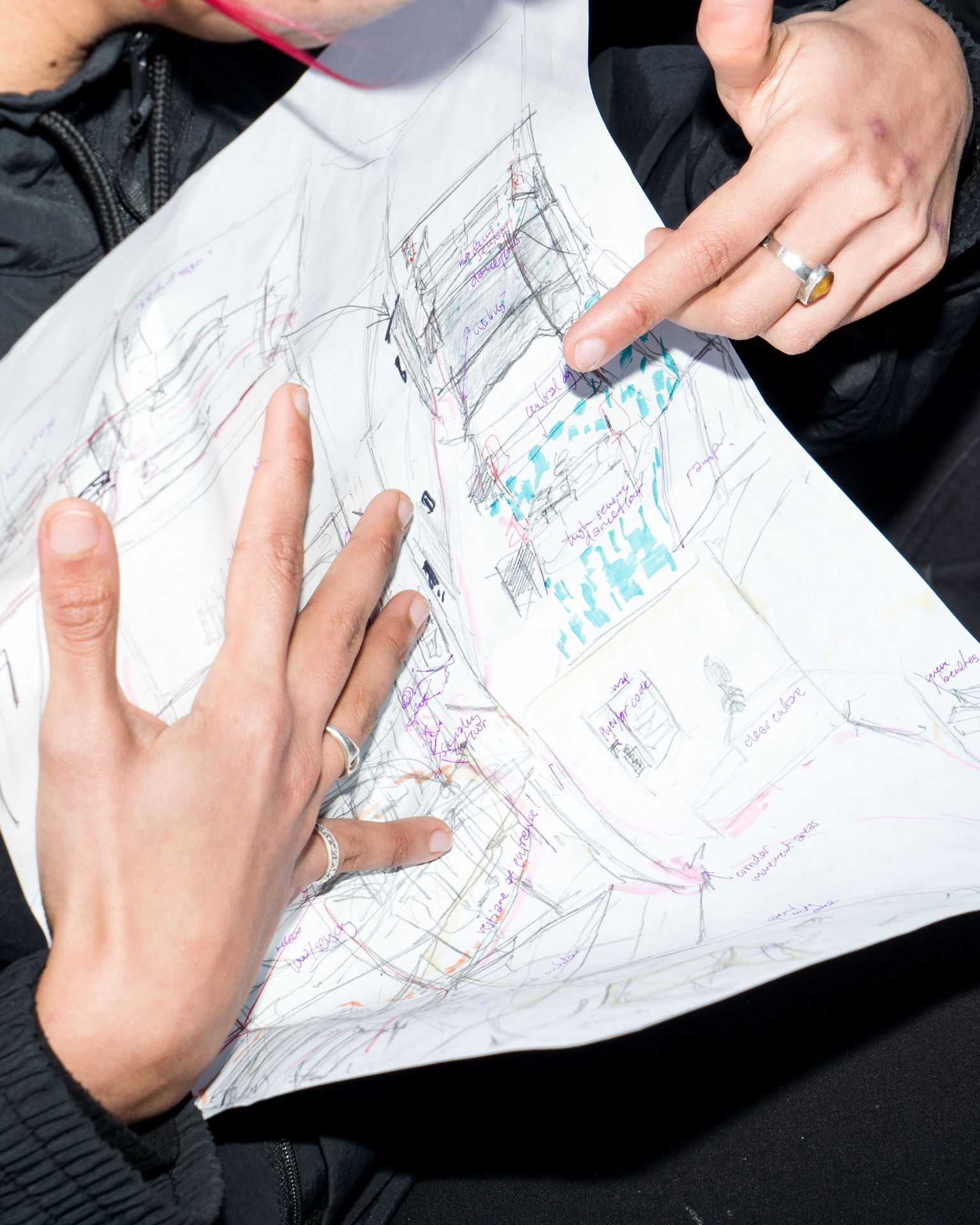
Somewhere mid February 2025, Club Dérive, Dancefloor Intimacy and MONTAGE launched an open call for their ‘Club Access Lab’. Together, in the weekend of the 7-9th March, they would host a workshop on accessible club design: the theme where the practices of the three collectives intersect.
On the one hand there is Dancefloor Intimacy, a London based ‘movement’ putting a broad understanding of ‘accessibility’ at the forefront of a vibrant nightlife culture. By gathering the lived experiences of clubgoers - a group which bans no disability or neurodiversity - and allowing them to unleash their imagination, Dancefloor Intimacy bridges the gap between research and actionable change, thus between the current - excluding - and optimal - inclusive - situations. In this endeavour, Club Dérive, is the perfect partner in crime. With space as their instrument and by relying on psychogeographic theories, CD's scenographies aim to be more than installations. Rather they are ‘ambiances’ - animated and appropriable settings, resulting from and at the same time stimulating an intense interaction between the objective environment and the individual subject. In the same way CD’s scenographies are not just installations, Montages events aim to be not just parties. With every event, Laura Conant and Jonathan Cant - founders of Montage - try to radically shift club conventions: however crazy an idea, it is never too crazy to explore.
On the part of Dancefloor Intimacy, there’s founder Ali Wagner - trained as product and industrial designer, focussing on social and environmental strategies for the nightlife and music industry - and for Club Dérive, there’s Clara Golfa Sambay - an Environmental and Prevention Management student - leading the Lab.
The joint workshop is then a trialogue in which two questions prevail:
- What does a utopian clubbing experience look like? and
- How do we build it?
To guide our thoughts, giving a clear direction to the experiment, our answers to these questions are to be translated into concrete design interventions, with the next Montage party in Recyclart - a multidisciplinary art, culture and club space in Molenbeek - as case study.
During the course of three days, we went from reality to utopia and back, balancing options and constraints, weighing out problems and solutions, navigating between past, present, future. The first day was all about establishing the theoretical framework on which to build. Ali laid out some central notions for understanding accessibility and disability: we talked about definitions and misconceptions, learned about the spoon theory and the notion of universal design, pinned the social model of disability against the medical one. (I won’t go into detail about these concepts here, but strongly encourage you to google them.) Armed with this theoretical foundation, we set out to do an in situ audit of Recyclart, aiming to understand the barriers that exist for people with access needs.
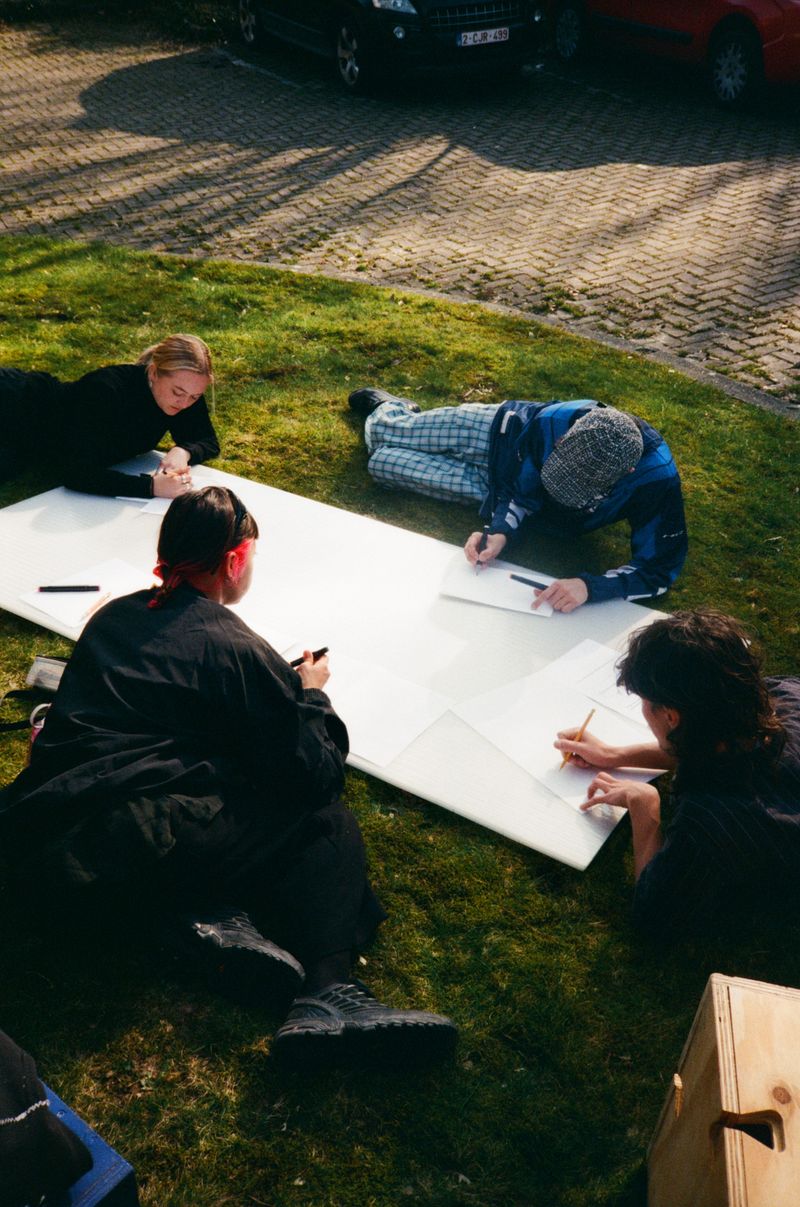
Identifying possible solutions for these barriers was the goal of the second day. With a post-it-exercise on how to turn theory into action, Clara guided us towards a collective brainstorm session. This session was set up as an exercise in stimulating behaviour change, encouraging us to approach design with greater awareness for accessibility. Gently we entered the realm of ideas, putting words and giving shapes to our own ultimate utopian club experiences - no scenario being too far-fetched, no fantasies too far-stretched.
On Sunday our rather floaty proposals were to land, in order to arrive at concrete designs with distinct forms and clear materiality.
Joining the workshop was a motley group of about 15 individuals, all as creative as colourful. Many have backgrounds in architecture and art, but there’s also experience in film, theatre, (health)care and gender studies. The multidisciplinary gang also brings with it a multi-layered reading of the world, due to their non-conforming engagement with it.
As a way of reflecting on this workshop, I gathered five overarching insights that struck me throughout the weekend, and continue to stuck with me. By not opting for a detailed report of our work, but rather choosing to share these lessons, I hope to spark your imagination. In this way, the Club Access Lab is an unending endeavour - and the experiment can keep going
"from reality to utopia and back"
Everything always starts with language
Finding yourself in a group of strangers, especially when you know you will be spending the next three days with them, is always a bit uncomfortable. The weight of making a good first impression can be heavy, but was, thanks to Ali and the CD members, immediately made a bit lighter. In presenting ourselves, we were asked for our pronouns and motivations. Stating why we wanted to join this specific workshop meant shedding a personal layer. Laying a vulnerability on the table and realising that there is space for that, immediately makes you feel more at ease. This aspect, together with clear communication about some rules - or rather desired behaviours -, contributes to the establishment of every safer space. We then went on to define the appropriate jargon - f.e. how we talk about people with certain disabilities. This linguistic clarity and transparency of information and communication on multiple levels - about correct vocabulary, about the planning, about the space, about ourselves and each other - created an immediate feeling of calmness. I felt welcome, at ease, safe.
Our designs - on day 2 - also departed from language. Having identified persisting barriers in Recyclart, we started to put into words our desired feelings and experiences. Wishes became words and words turned into concepts. Collectively, we realised that the design of an accessible club is about emotions and discovered wordplay as the ultimate scenographical strategy - a shared understanding stemming from our differences.
Nothing good never comes from thinking in(side) boxes
A correct and inclusive reading of our physical environment starts by realising that the world as we know it is, for the most part, made by and thus made for one type of person: the white, neurotypical and straight male, with an average height and average weight, and no visible nor invisible disability. This, of course, poses problems for the majority of people, who do not conform to this norm, so on a fundamental level, our physical world is not made to accommodate to variety and diversity. Pursuing accessibility means being conscious of the ubiquity of barriers… and especially of their anonymity. Through the concept of intersectionality we know that no human will ever know all barriers, since there’s as many personal experiences as there is people on this earth.
Creating accessible spaces means overthrowing the conventions we have grown up with. Change can only occur by thinking outside the normative box. Inclusivity can only come from diversity: we need multitudes to tackle the issue of accessibility.
Accessibility means giving people options
Though accessibility shouldn’t be an issue… Today, focussing on accessibility mostly means finding solutions to a problem, but what is deemed ‘problematic’ is often arbitrary. Think about the social model of disability, for example, which states, contrary to medical beliefs, that the disability of a person is itself not a problem, but that the world as it exists poses problems for the disabled. Therefore just overthrowing the convention - solely looking for answers to questions - is not enough: accessibility should be seen as a premise, a potentiality, a catalyst for social equality and interconnectedness. ‘Accessible’ is then not just an adaptation of a certain standard, but means making stuff that from the start benefits everyone and can be appropriated, though should never have to be adapted.
Two of Ali’s aphorisms I will from now on take with me in everything I make - and I hope we all do.
- Designing for the minority means designing for the majority
- Accessibility means giving people options.(Not so coincidentally, this second point - of working towards maximum ‘variety’ - is also reflected in Club Dérives ‘design tactics'.)
Process and product are two sides of the same coin
In a way, the whole weekend was a metaphor for what we would like our (club) experiences to be. When we describe our utopian club nights, we speak of smooth transitions - be it in music, space, lights, materials -, of being clearly informed, of diverse and nice people, of feeling as if we’re part of one organic collective choreography, of not being abruptly interrupted, of being taken care of… One time throughout the workshop we were presenting individual proposals to the group, and it was almost as if we had beforehand agreed on who would talk after who. We seemed to follow a choreo that no one knew about… which was sweet to witness.
I truly believe that process and product are not separate modes of production. Rather they are two sides of the same coin. This insight is therefore an ode to a kind of coherence that is crucial in all we endeavour to do. If you want your designs to be accessible, make sure your practice is too. If you want your projects to be nice, make sure you are too. Creation is a matter of honesty - what you want your designs to achieve should be reflected in the process of achieving it. I am convinced this is one of the most interesting design strategies in general.
This Residency was subsidised by afondsbrussels.